Printing Kiosk vs Traditional Print Shop: A Complete Comparison (2025)
Side-by-side comparison of self-service printing kiosks and traditional print shops across cost, operations, privacy, scalability, and customer experience — with a verdict for entrepreneurs.
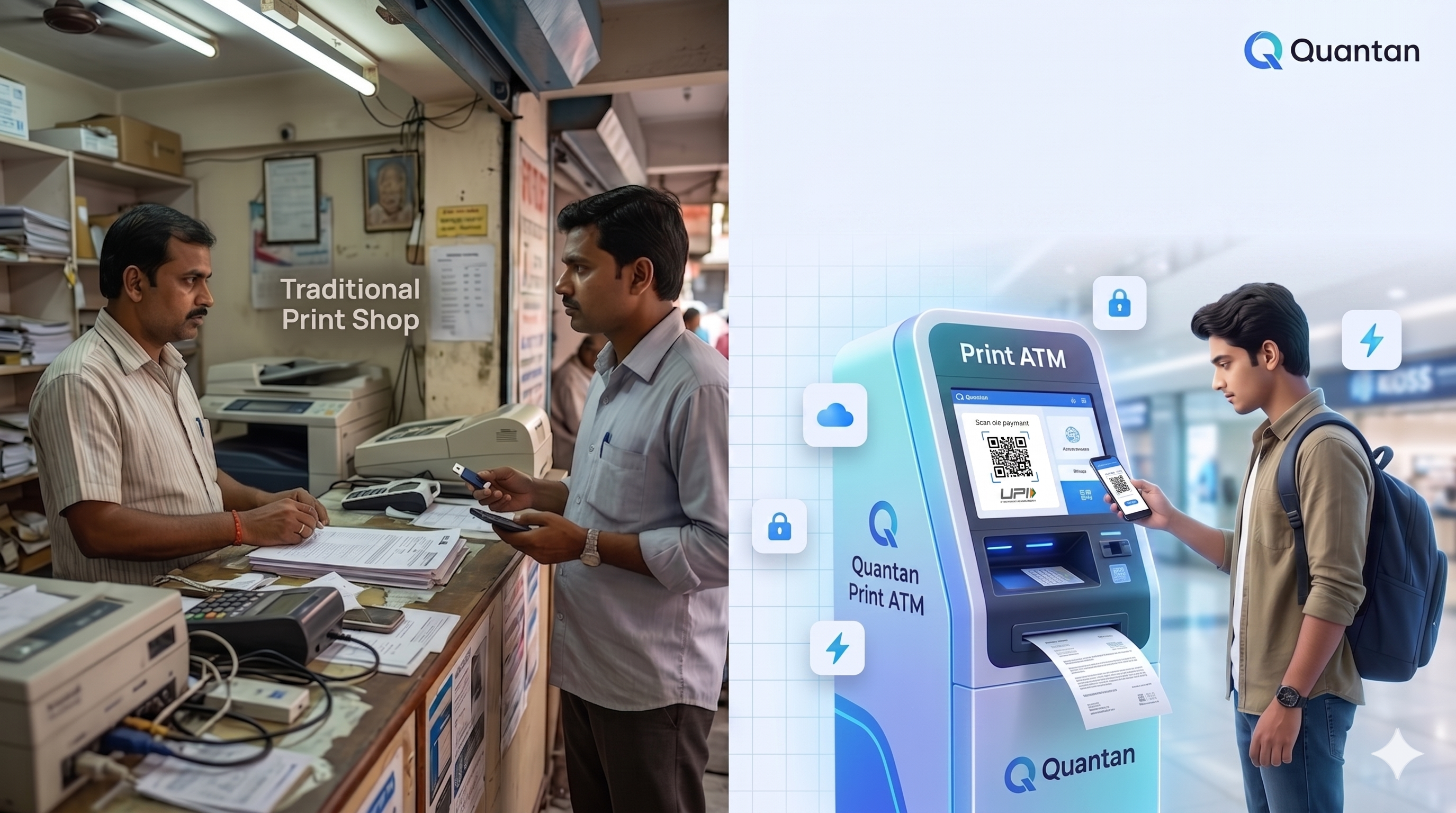
India's printing market sits at an interesting inflection point. Traditional Xerox shops have served millions of customers for decades. Self-service printing kiosks — Print ATMs — are now challenging that model. If you are deciding which business to start, or which solution to deploy for your institution, this comparison gives you the full picture.
Business Model Overview
Traditional Print Shop
A traditional print shop is a counter-operated business. Customers walk in, hand over a USB drive or WhatsApp a file, specify their requirements verbally, pay cash or a manual QR, and wait for an operator to process the job. The model relies entirely on staff availability — no staff, no service.
Quantan Self-Service Kiosk
A Quantan kiosk is an automated Print ATM. The customer scans a QR code, uploads their file securely from their phone, selects print settings, pays via UPI, and collects the printout — entirely self-directed. The owner monitors operations and revenue remotely via the Quantan dashboard.
Head-to-Head Comparison
| Factor | Traditional Print Shop | Quantan Kiosk |
|---|---|---|
| Setup cost | ₹3–8 lakh (shop rent + fit-out + staff) | ₹89,999–₹1,99,999 (excl. GST) for the Quantan kiosk, plus a flat 3% platform fee |
| Operating hours | 10–12 hours/day | 24 / 7 |
| Staff required | 1–3 operators | 0 for printing; 1 part-time for consumables |
| File sharing | WhatsApp / USB (unsecured) | Encrypted QR upload |
| Payment | Cash / manual QR | Integrated UPI with auto-reconciliation |
| Wait time | 5–30 min (queue-dependent) | Under 2 minutes (self-serve) |
| Scalability | Each new location needs new staff | New kiosk managed from same dashboard |
| Revenue visibility | Manual tallying | Real-time dashboard analytics |
| Customer privacy | File may remain on shop PC | File deleted after printing |
| Space required | 200–500 sq ft | 10–15 sq ft |
Where Traditional Print Shops Still Win
Traditional shops are not obsolete — they remain the better option for complex, assisted print services that require human judgment:
- Large-format printing (banners, flex boards, posters)
- Design and layout services (brochures, visiting cards)
- Binding, lamination, and spiral binding
- Bulk institutional orders with custom specifications
- Customers who need in-person guidance for document preparation
Where Quantan Kiosks Win Decisively
For standard document printing — the overwhelming majority of daily print jobs — kiosks outperform shops on every operational metric:
- A4 black-and-white documents (assignments, forms, resumes)
- A4 colour documents (certificates, reports, presentations)
- Locations where staff deployment is impractical (hostels, transit hubs)
- Businesses seeking passive, scalable income across multiple locations
- Institutions prioritising student privacy and digital-first workflows
"For 90% of daily print jobs, a Quantan kiosk is faster, safer, and more cost-effective than a traditional counter. The remaining 10% still needs a shop — and we're fine with that."
— Quantan Product Team
The Hybrid Strategy: Upgrade Your Shop with a Kiosk
Many of Quantan's best-performing partners are traditional print shop owners who added a kiosk. The kiosk handles standard self-service jobs autonomously while the operator focuses on complex, higher-margin work. Revenue goes up. Queue pressure goes down. Customer satisfaction improves.
Compare Plans and Get a Quote
Quantan's team will help you decide whether a standalone kiosk, a hybrid setup, or a full software deployment is right for your situation.
Talk to QuantanElevate Your Print Business
Ready to see how our automation solutions can transform your daily operations and boost your bottom line?